

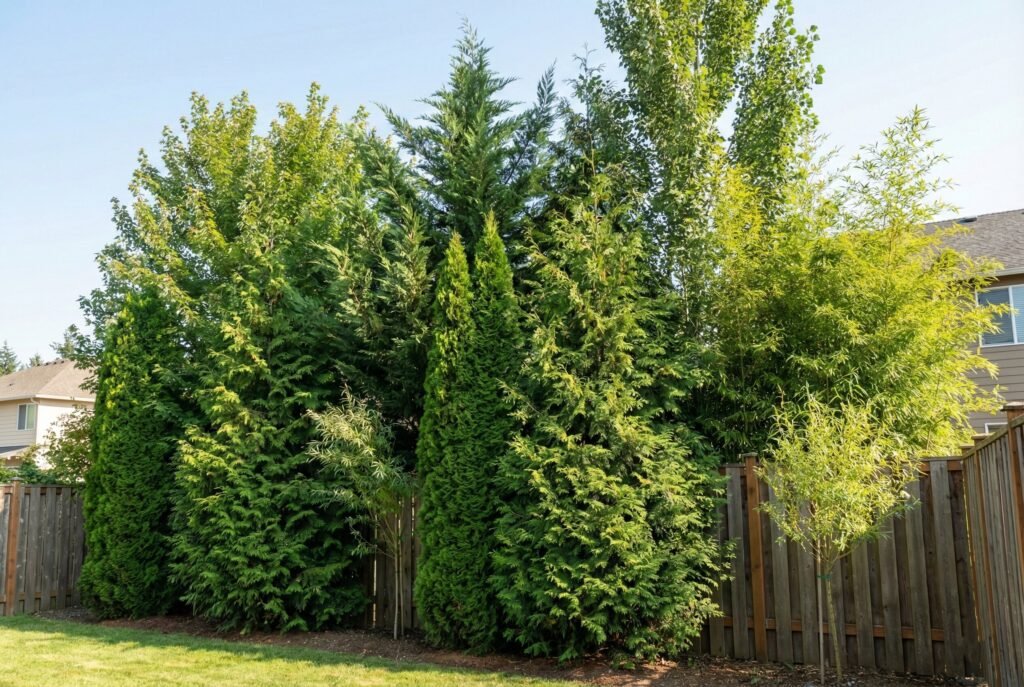
Privacy is one of the most valuable features of a home. Whether you live in a busy subdivision, near a bustling street, or simply want to block the view of a neighbor’s window, creating a natural barrier is a smart investment. While fences are an immediate solution, they often have height restrictions and can feel confining.
Trees offering a “living fence” provide a softer, more beautiful alternative. They reduce noise, block wind, improve air quality, and increase your property value. The biggest challenge with planting trees is usually the wait. However, by choosing the right fast-growing varieties, you can establish a lush, green screen in just a few years.
This guide explores the best fast-growing trees for privacy, covering their growth rates, care requirements, and why they are perfect for your yard.
What to Consider Before Planting a Privacy Screen
Before buying saplings, you must evaluate your specific landscape conditions. Ignoring these factors can lead to trees that struggle to grow or become dangerous liabilities in the future.
Hardiness Zones
The USDA Plant Hardiness Zone Map is the standard by which gardeners and growers can determine which plants are most likely to thrive at a location. You need to know your zone to ensure the tree can survive your region’s winter lows and summer highs.
Available Space
“Fast-growing” often means “large.” You must consider not just the height, but the spread (width) of the tree at maturity. Planting large trees too close to your house, septic tanks, or power lines can cause expensive damage.
Evergreen vs. Deciduous
For year-round privacy, evergreen trees are the superior choice. They keep their foliage all winter. Deciduous trees lose their leaves in the fall. While deciduous trees can block views during the summer BBQ season, they leave you exposed in the winter. Most of the trees on this list are evergreens for this reason.
Growth Rate
In the world of landscaping, a “fast” growth rate usually means the tree grows 1.5 to 2 feet or more per year. Some “super” fast growers can achieve 3 to 5 feet in a single year under optimal conditions.
The Top 12+ Fast-Growing Privacy Trees
Here are the top recommendations for creating a natural privacy shield.
1. Thuja Green Giant (Thuja standishii x plicata)
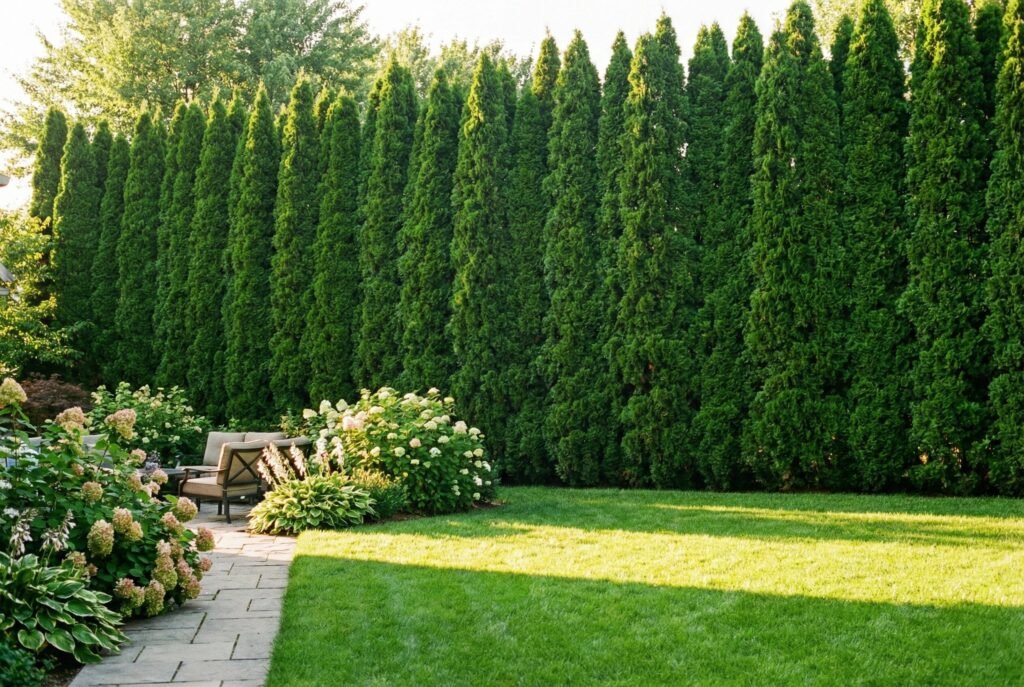
The Thuja Green Giant is widely considered the king of privacy trees in the United States. It is a hybrid arborvitae that is exceptionally tough, disease-resistant, and adaptable to various soil types. Unlike other arborvitae that turn brown in winter, the Green Giant stays a rich, deep green.
Why It Is Great:
This tree is virtually indestructible once established. It tolerates drought better than the Leyland Cypress and has a uniform, conical shape that requires very little pruning. It can grow 3 to 5 feet per year, meaning a small starter tree can become a massive barrier in less than a decade.
Quick Stats:
- Growth Rate: 3–5 feet per year
- Mature Height: 40–60 feet
- Mature Spread: 12–18 feet
- Hardiness Zones: 5–9
- Sunlight: Full sun to partial shade
Best Use Case: large backyards where you need a tall, dense wall to block a two-story house next door.
2. Leyland Cypress (Cupressus × leylandii)
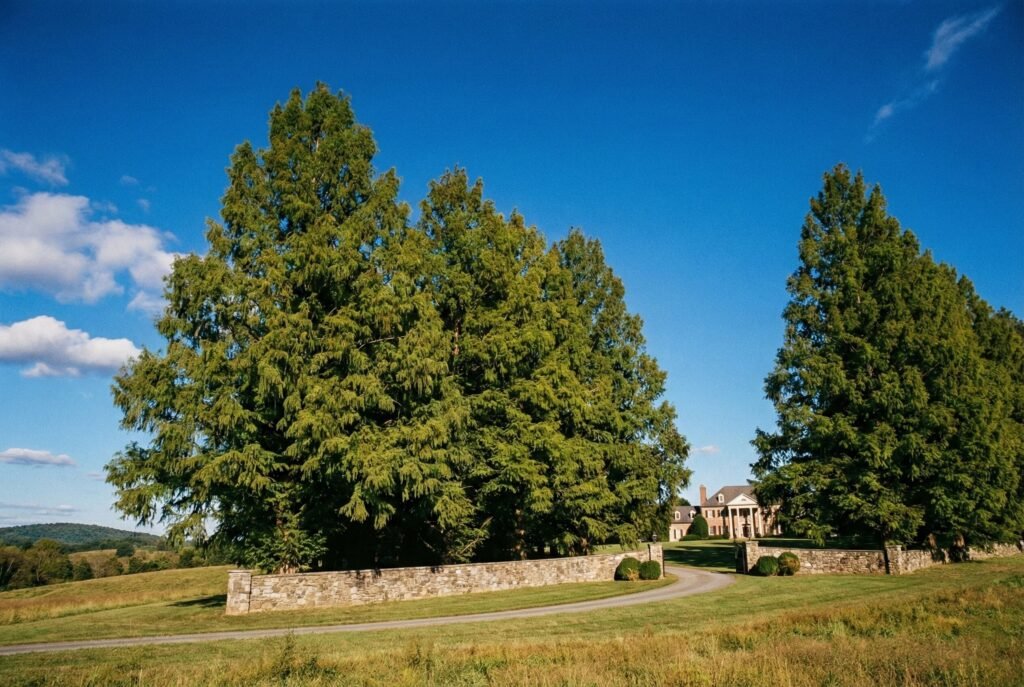
For years, the Leyland Cypress was the go-to tree for privacy. It is incredibly fast-growing and creates a fine, feathery texture that is soft to the touch. It grows tall and wide, rapidly filling in gaps between trees.
Why It Is Great:
Speed is the main selling point. If you need a screen “yesterday,” the Leyland Cypress is a top contender. Its bluish-green foliage is very dense, making it an excellent windbreak and sound barrier.
Important Note:
Leyland Cypress can be susceptible to fungal diseases like Seiridium canker, especially in hot, humid climates where air circulation is poor. To prevent this, plant them with plenty of space in between so air can flow through the branches.
Quick Stats:
- Growth Rate: 3–4 feet per year
- Mature Height: 60–70 feet
- Mature Spread: 15–25 feet
- Hardiness Zones: 6–10
- Sunlight: Full sun
Best Use Case: Large properties in milder climates needing rapid coverage on a budget.
3. Willow Hybrid (Salix x matsudana x alba)
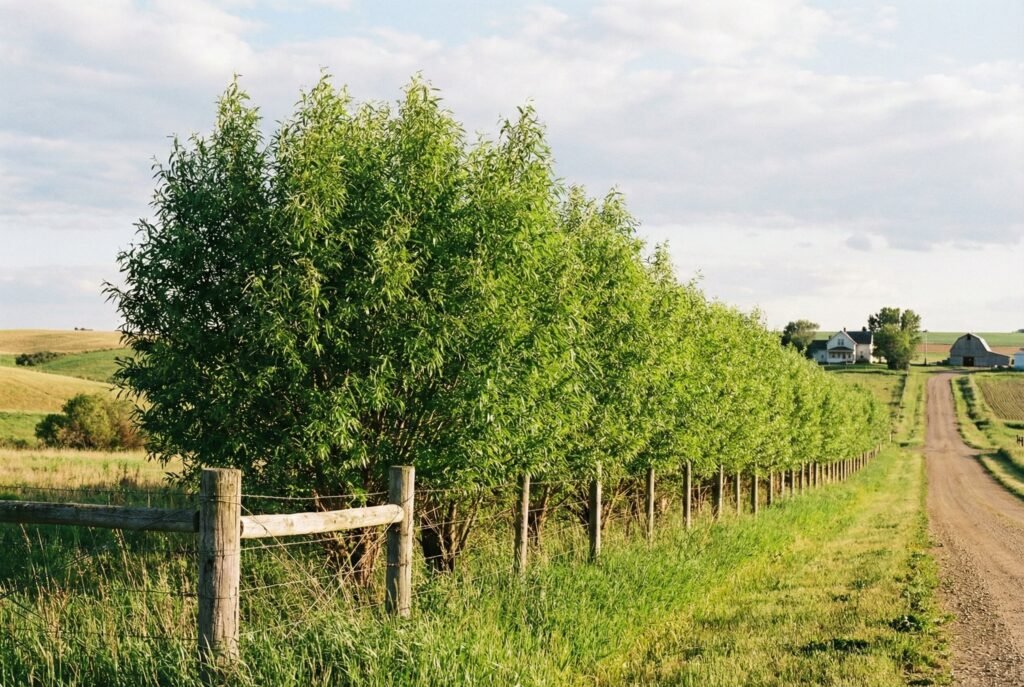
If you prioritize speed over everything else, the Willow Hybrid is the winner. Technically a deciduous tree, it holds its leaves very late into the year and leafs out very early in spring, providing a near-year-round screen. It is not a weeping willow; it grows upright.
Why It Is Great:
It is one of the fastest-growing trees available, capable of growing over 6 feet in a single year. It is also very tolerant of wet soil, making it a great choice for low-lying areas of your yard that tend to stay damp.
Important Note:
Like all willows, this tree has an aggressive root system. Do not plant it near sewer lines, septic fields, or pools. It also has a shorter lifespan (around 30–50 years) compared to conifers.
Quick Stats:
- Growth Rate: 6–10 feet per year
- Mature Height: 35–45 feet
- Mature Spread: 20–30 feet
- Hardiness Zones: 4–9
- Sunlight: Full sun to partial shade
Best Use Case: Plugging a gap quickly or establishing a windbreak in a wet area away from structures.
4. Emerald Green Arborvitae (Thuja occidentalis ‘Smaragd’)
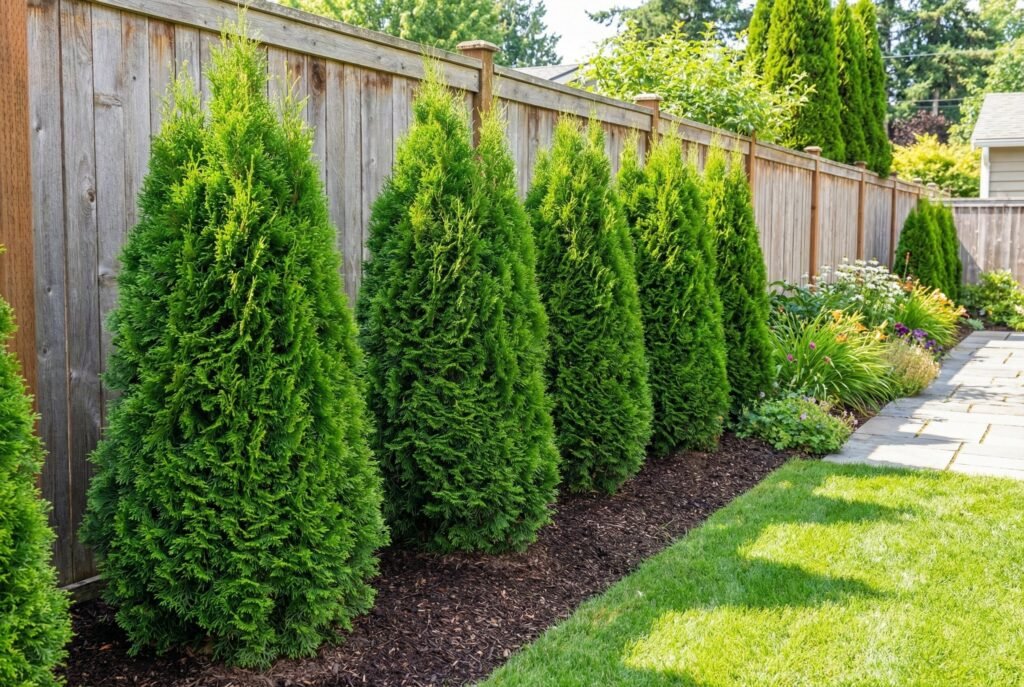
Not everyone has space for a 60-foot giant. The Emerald Green Arborvitae is the perfect solution for smaller suburban yards. It is a slower grower than the Green Giant, but it is much more compact and manageable.
Why It Is Great:
It maintains a tight, pyramidal shape naturally, so you almost never have to trim it. As the name suggests, the foliage is a striking, shimmering emerald color. It is excellent for planting in tight rows along a fence line without eating up your entire yard.
Quick Stats:
- Growth Rate: 1–2 feet per year
- Mature Height: 12–15 feet
- Mature Spread: 3–4 feet
- Hardiness Zones: 3–8
- Sunlight: Full sun
Best Use Case: Townhomes, small backyards, or side yards where horizontal space is limited.
5. Eastern White Pine (Pinus strobus)
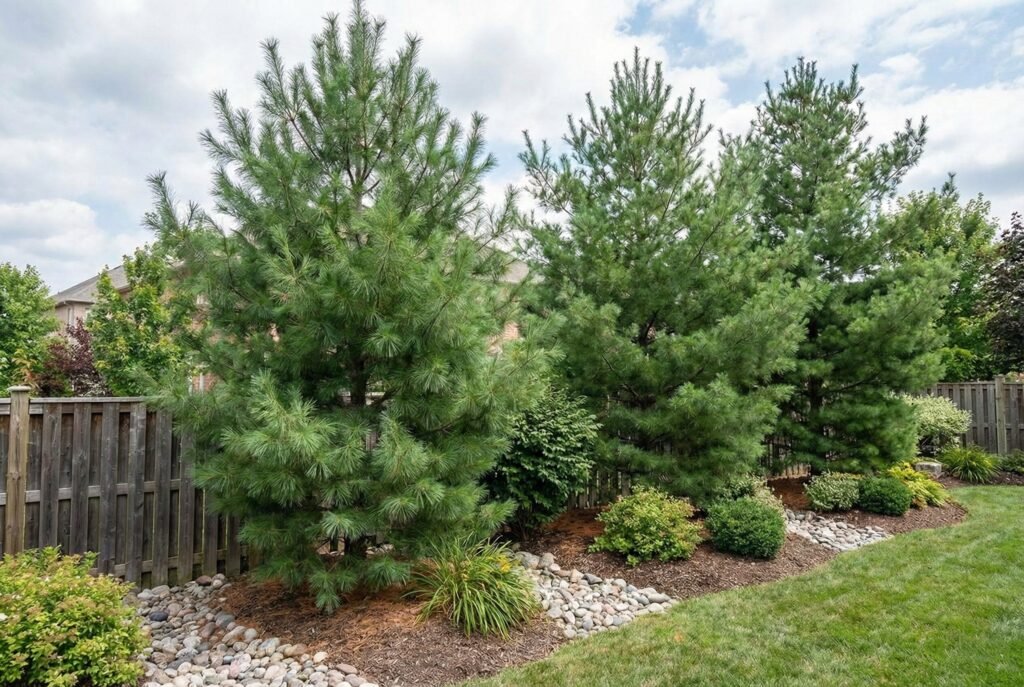
For a more natural, forest-like look, the Eastern White Pine is a classic choice. It is a native North American tree with long, soft needles and a majestic presence.
Why It Is Great:
It breaks up the monotony of generic hedge walls. It grows very fast and is extremely cold-hardy. While it doesn’t create a solid “wall” like an arborvitae, its dense branches effectively filter views and block noise. It is also a haven for birds and local wildlife.
Quick Stats:
- Growth Rate: 2+ feet per year
- Mature Height: 50–80 feet
- Mature Spread: 20–40 feet
- Hardiness Zones: 3–8
- Sunlight: Full sun to partial shade
Best Use Case: Large properties seeking a natural woodland border rather than a manicured hedge.
Getty Images
6. Nellie R. Stevens Holly (Ilex x ‘Nellie R. Stevens’)
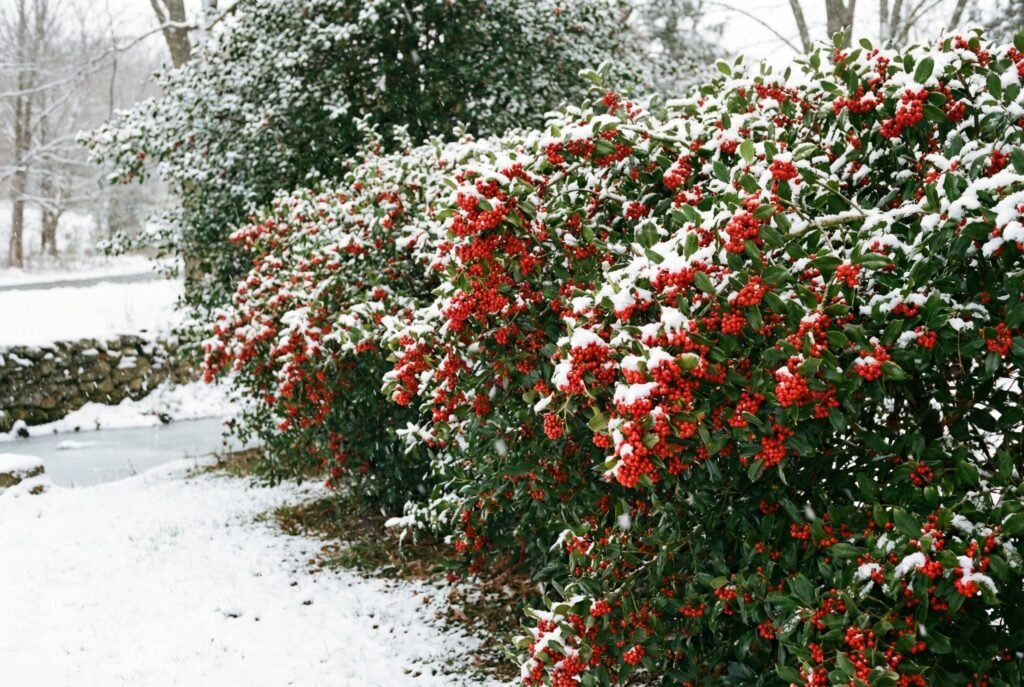
This is the ideal choice if you want privacy combined with security and color. The Nellie R. Stevens is a broadleaf evergreen, meaning it has leaves rather than needles.
Why It Is Great:
It produces beautiful, bright red berries in the winter, adding a pop of color when everything else is grey. The leaves are glossy, dark green with spiny margins. This spiny texture makes it an excellent security barrier—animals and intruders will think twice before trying to push through a Holly hedge.
Quick Stats:
- Growth Rate: 2–3 feet per year
- Mature Height: 15–25 feet
- Mature Spread: 8–12 feet
- Hardiness Zones: 6–9
- Sunlight: Full sun to partial shade
Best Use Case: Front yards or property lines where you want security and winter decoration.
7. Lombardy Poplar (Populus nigra ‘Italica’)
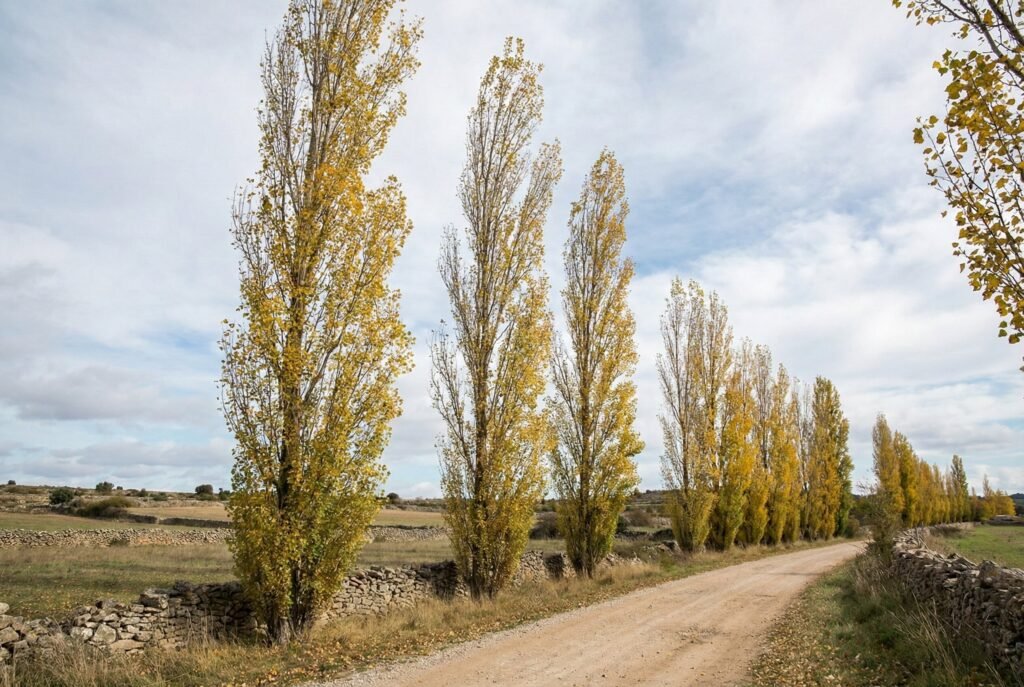
The Lombardy Poplar is famous for its unique shape. It grows straight up like a column, resembling an exclamation point in the landscape.
Why It Is Great:
It is incredibly distinct and adds a Mediterranean or European flair to a property. Because the branches grow upward parallel to the trunk, the tree has almost no spread. You can plant them very close together (8 feet apart) to create a tall windbreak without losing yard space.
Important Note:
Like the Willow, this tree is prone to disease and cankers, often resulting in a shorter lifespan (sometimes only 15-20 years). Use them for quick results while slower, longer-lived trees mature behind them.
Quick Stats:
- Growth Rate: 6 feet per year
- Mature Height: 40–60 feet
- Mature Spread: 10–15 feet
- Hardiness Zones: 3–9
- Sunlight: Full sun
Best Use Case: lining a long driveway or creating a distinct architectural border on a large estate.
Shutterstock
8. Cryptomeria Radicans (Cryptomeria japonica ‘Radicans’)
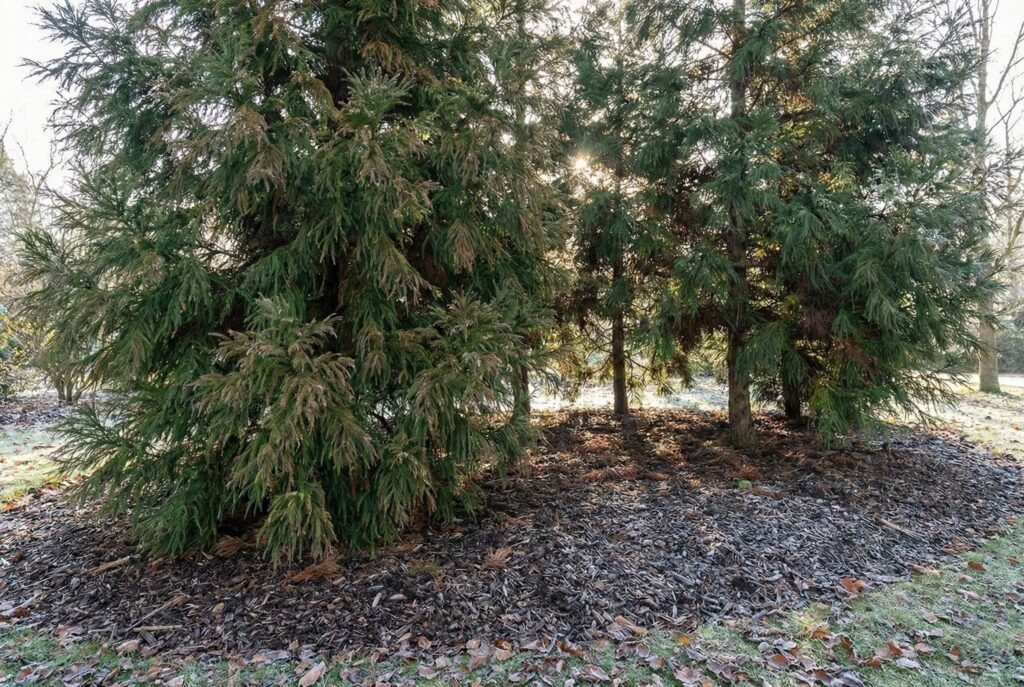
Also known as Japanese Cedar, the Cryptomeria is a sophisticated alternative to the standard Leyland Cypress. It offers a different texture and color profile.
Why It Is Great:
It grows in a tall, slender pyramid shape. The foliage is soft and feathery but denser than a cypress. In the winter, the needles often take on a pleasant bronze or purple hue, adding seasonal interest. It is also more disease-resistant than the Leyland Cypress.
Quick Stats:
- Growth Rate: 3–4 feet per year
- Mature Height: 30–40 feet
- Mature Spread: 15–20 feet
- Hardiness Zones: 5–9
- Sunlight: Full sun to partial shade
Best Use Case: A stand-alone specimen or a privacy screen in a high-end landscape design.
9. Wax Myrtle (Morella cerifera)
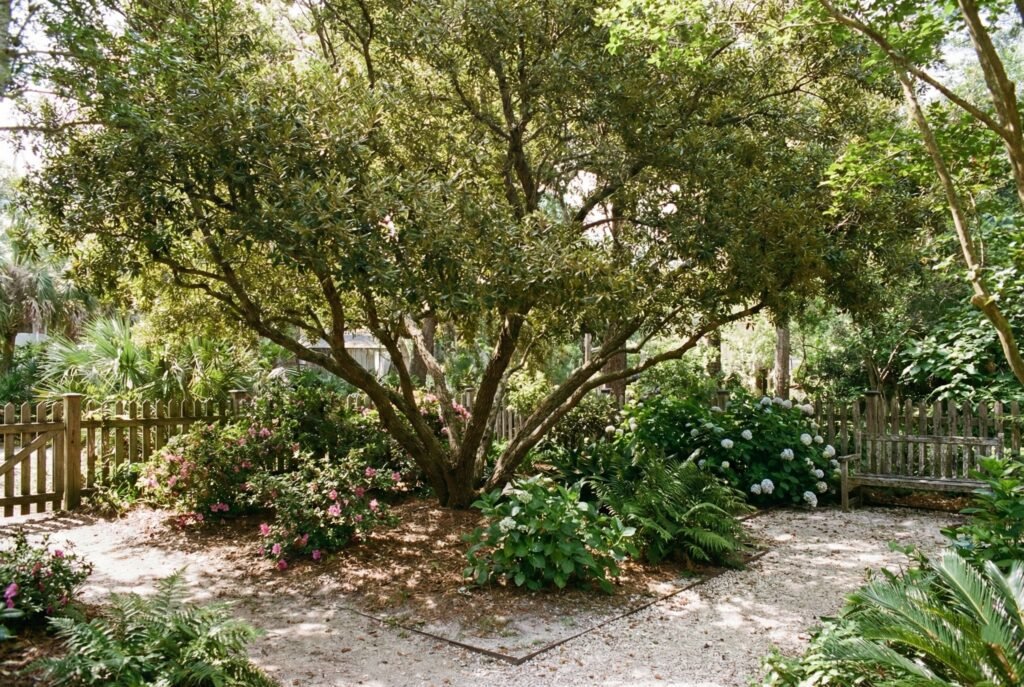
For those living in warmer, coastal climates, the Wax Myrtle is a superstar. It is a native evergreen shrub that can be trained into a small multi-trunk tree.
Why It Is Great:
It is incredibly salt-tolerant, making it perfect for beach homes or roadside planting where road salt is an issue. It has aromatic, olive-green leaves and produces waxy, gray berries. It handles sandy soil and high heat with ease.
Quick Stats:
- Growth Rate: 3–5 feet per year
- Mature Height: 15–20 feet
- Mature Spread: 20–25 feet
- Hardiness Zones: 7–10
- Sunlight: Full sun to partial shade
Best Use Case: Coastal properties, southern gardens, and casual, unstructured privacy screens.
10. Italian Cypress (Cupressus sempervirens)
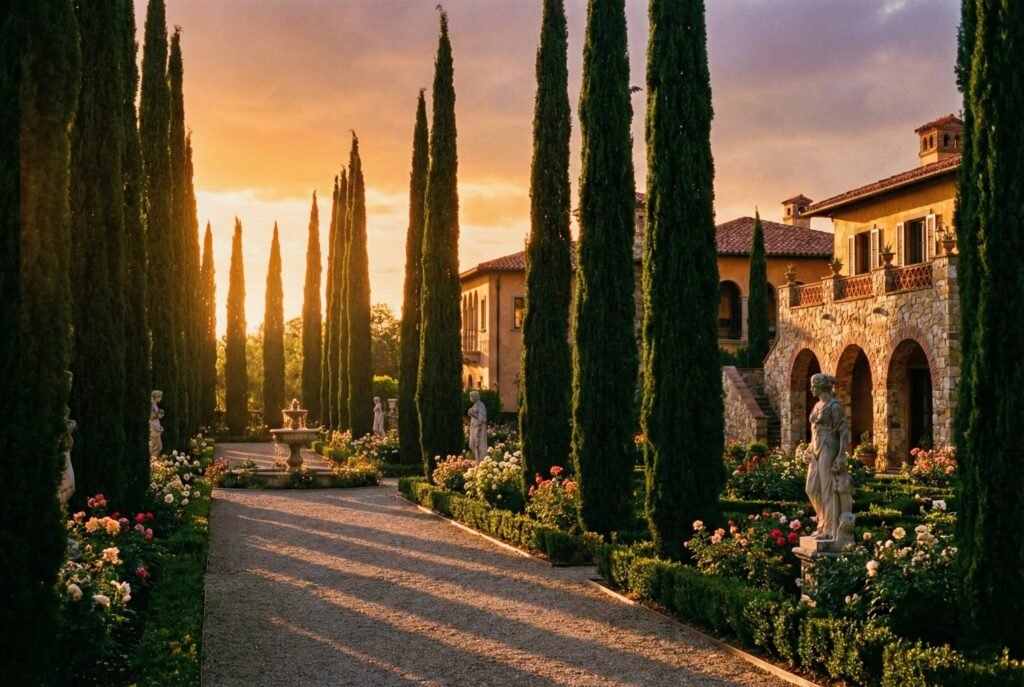
If you have a narrow space but need significant height, the Italian Cypress is the answer. This is the tree famously seen in Tuscan landscapes.
Why It Is Great:
It never gets wide. It grows straight up in a very tight column, rarely exceeding 5 feet in width even when 40 feet tall. This makes it perfect for narrow side yards between houses where you need to block a second-story window without the branches touching your siding.
Quick Stats:
- Growth Rate: 3 feet per year
- Mature Height: 40–60 feet
- Mature Spread: 3–5 feet
- Hardiness Zones: 7–10
- Sunlight: Full sun
Best Use Case: Tight urban spaces, formal entrances, and Mediterranean-themed gardens.
11. Silver Maple (Acer saccharinum)
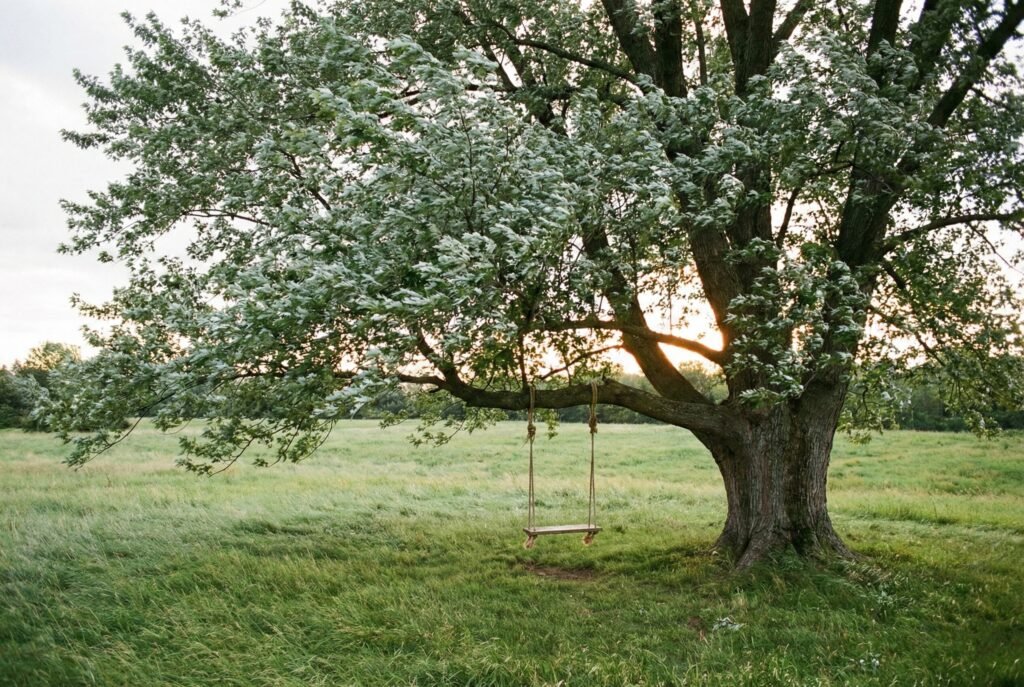
While most privacy trees are evergreens, sometimes you want summer shade and privacy, but winter sun. The Silver Maple is a massive deciduous tree that grows aggressively.
Why It Is Great:
It provides thick, cooling shade in the summer months. The leaves have a beautiful silvery underside that shimmers in the breeze. Because it is deciduous, it allows sunlight to warm your home in the winter when the leaves drop.
Important Note:
This tree has powerful surface roots that can crack sidewalks and driveways. Plant it far away from hardscape.
Quick Stats:
- Growth Rate: 3–7 feet per year
- Mature Height: 50–80 feet
- Mature Spread: 35–50 feet
- Hardiness Zones: 3–9
- Sunlight: Full sun to partial shade
Best Use Case: Large backyards needing both privacy from high angles and deep shade.
12. Dawn Redwood (Metasequoia glyptostroboides)
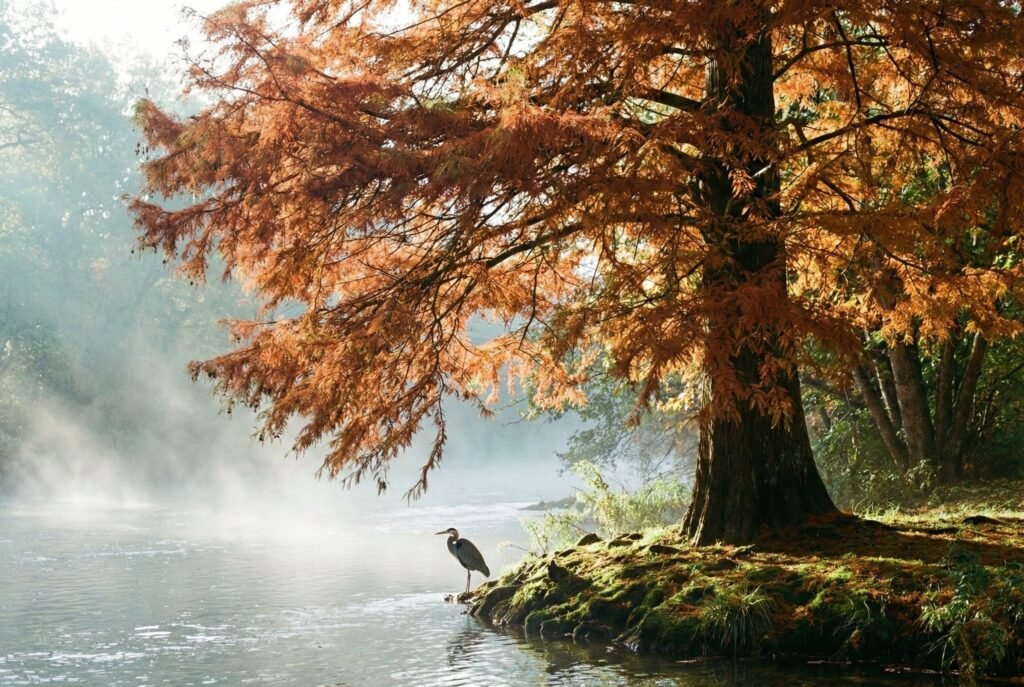
The Dawn Redwood is a living fossil. It was thought to be extinct until it was rediscovered in China in the 1940s. It is a deciduous conifer, meaning it has needles like a pine, but they turn orange and drop off in the fall.
Why It Is Great:
It is one of the fastest-growing trees in existence. It has a unique, feathery texture and turns a stunning rusty-orange color in the autumn. It thrives in wet soil where other trees might rot.
Quick Stats:
- Growth Rate: 4+ feet per year
- Mature Height: 70–100 feet
- Mature Spread: 25 feet
- Hardiness Zones: 4–8
- Sunlight: Full sun
Best Use Case: Large estates with damp soil or a pond edge, looking for a unique specimen that blocks views rapidly.
Bonus Idea: Clumping Bamboo (Bambusa varieties)

While not technically a tree (it is a grass), bamboo is the fastest-growing privacy plant on earth.
Why It Is Great:
Some varieties can grow several feet in a single week. It creates an Asian-inspired, zen aesthetic and produces a calming rustling sound in the wind.
Important Note:
Only plant Clumping Bamboo. Avoid “Running Bamboo” at all costs. Running bamboo is invasive and will take over your yard and your neighbor’s yard. Clumping bamboo stays in a tight circle and expands slowly outward.
Best Use Case: Modern or Zen gardens needing an immediate screen.
How to Plant Your Privacy Trees for Maximum Effect
Choosing the tree is step one. Planting it correctly is step two. Here are the secrets to a successful privacy screen.
1. Dig the Right Hole
The hole should be twice as wide as the root ball but no deeper. If you plant the tree too deeply, the roots will suffocate. The top of the root ball should be slightly above the surrounding soil level.
2. Don’t Plant in a Straight Line
If you have the space, avoid planting a single straight row. If one tree dies in a straight row, it leaves a gaping hole that looks like a missing tooth. Instead, use a staggered pattern. Plant two rows in a zig-zag formation. This creates a thicker sound barrier and ensures that if one tree has issues, the trees behind it fill the visual gap.
3. Mind the Spacing
It is tempting to plant trees very close together to get “instant privacy.” This is a mistake. As they grow, they will compete for water and nutrients, leading to brown, dead branches in the middle. Follow the spacing guidelines for your specific tree variety.
4. Mulch and Water
Mulch is critical. It keeps the soil cool and retains moisture. Apply a 3-inch layer of mulch around the base, but do not pile it against the trunk (this is called “volcano mulching” and can kill the tree). Water deeply and regularly for the first two years until the root system is established.
Final Thoughts
You do not have to live in a fishbowl. By planting one of these fast-growing varieties, you can reclaim your backyard sanctuary. Whether you choose the indestructible Thuja Green Giant, the secure Nellie R. Stevens Holly, or the architectural Italian Cypress, the best time to plant is now. The sooner you get them in the ground, the sooner you will enjoy the peace and quiet of a private landscape.